 Buy this domain
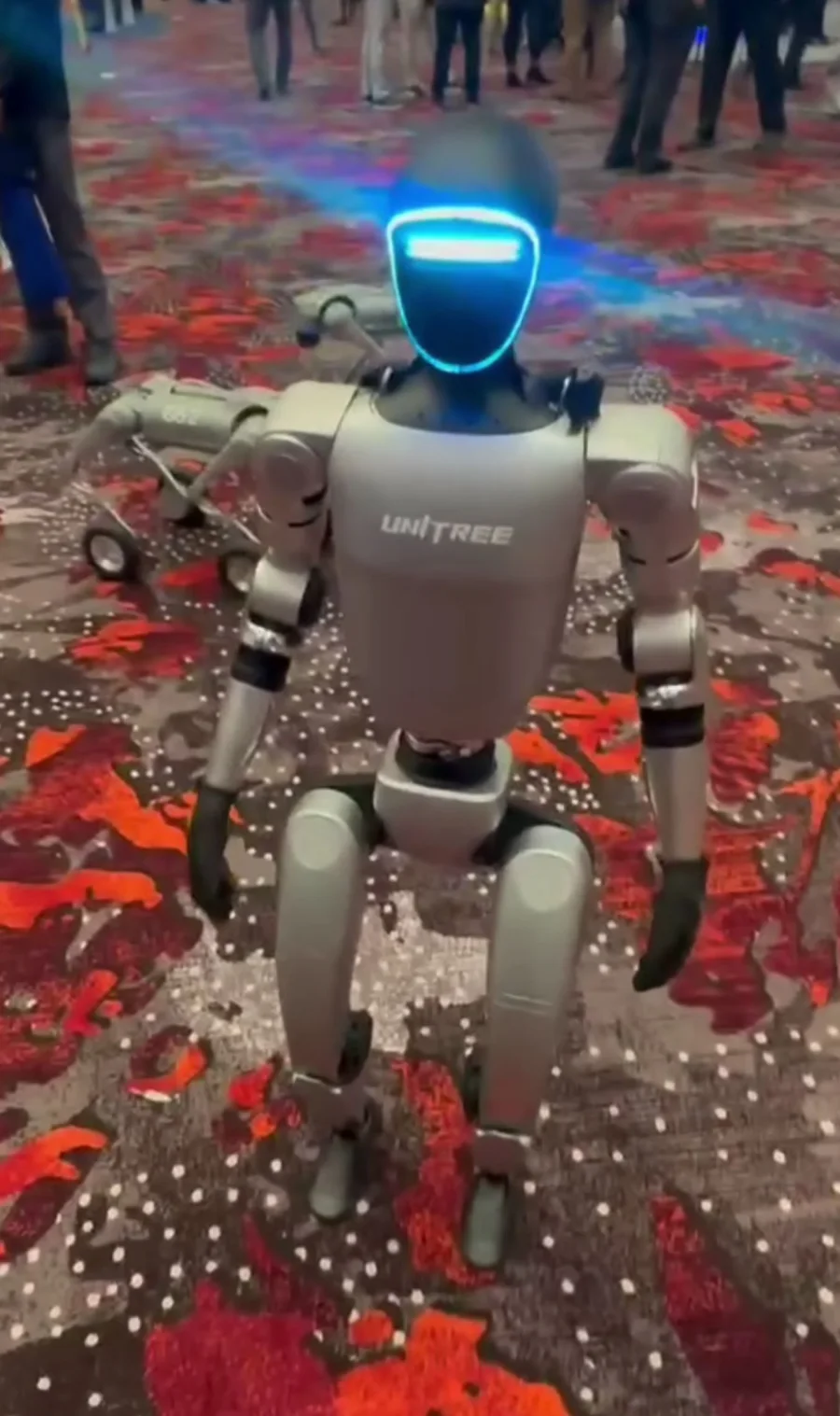
Unitree’s stock market filing has produced the most concrete output figure in China’s humanoid robot industry so far. According to its STAR Market prospectus, as reported by China Daily, the Hangzhou company shipped more than 5,500 humanoid robots in 2025, not counting wheeled dual-arm robots. Across 2023 to 2025 it sold 33,294 quadruped robots and 5,632 humanoids. The prospectus also ranks Unitree first in the world by humanoid shipments, a ranking the press reports do not source further.
Note the two measures. “Shipped” in 2025 and “sold” over three years are counted differently, and the press reports do not reconcile them. Anyone using the figure should cite it as Unitree’s shipment count, not as robots in use.
Humanoids became the main business
Revenue rose to 1.70 billion yuan in 2025 from 392.77 million yuan in 2024 and 159.13 million yuan in 2023. Net profit was 278.21 million yuan, while profit attributable to the parent after excluding non-recurring items was 590.75 million yuan. Humanoid robots brought in 868 million yuan, or 51.78 percent of revenue, according to the Global Times. In 2023 they were 1.88 percent, and four-legged robots were 75.78 percent. Unitree reported a gross margin of 60.13 percent for its core businesses.
Overseas sales were 731.66 million yuan in 2025, or 43.65 percent of main-business revenue. That fits the wider trade numbers China Daily cited from customs data: China became a net exporter of industrial robots for the first time in 2025, and exports of what customs calls intelligent biomimetic robots passed 10,000 units in the first half of 2026.
The offering
The Shanghai Stock Exchange accepted Unitree’s application on March 20, the listing committee approved it on June 1, and the securities regulator cleared registration on July 2. Unitree offered about 40.45 million shares at 150.80 yuan each, 10 percent of the enlarged share capital, for about 6.10 billion yuan in gross proceeds. Subscriptions opened on August 10. The shares began trading on August 19 and closed their first day at 845 yuan, about 460 percent above the offer price, valuing the company at around US$50 billion, Reuters reported.
Unitree plans to put 4.20 billion yuan into four projects: 2.022 billion yuan for robot model research, 1.11 billion yuan for robot body development, 445 million yuan for new products and 624 million yuan for a manufacturing base. Nearly half goes to AI models, not factories.
What the filing does not tell us
The prospectus reports do not break down who bought the robots or what they do. Reuters, in its coverage of the debut, said many of Unitree’s products are sold to research institutions and universities and that few of its robots are used in commercial settings. Unitree’s own G1 product page is candid about the state of the field.
“Currently, the global humanoid robot industry is in the early stages of exploration.”
Unitree, on its G1 product page
A $13,500 G1 sold to a university lab and a robot doing paid work in a factory count the same in a shipment total. The figure measures how many robots Unitree can build and sell, which is valuable. It does not measure deployment.
Exports also carry a new risk. Reuters reported that in July the U.S. Federal Communications Commission banned imports of future models of foreign-made humanoid and quadruped robots, including Unitree’s, citing national security, and that the Pentagon added Unitree to its list of Chinese military companies in June. Unitree says its robots are for civilian use.
Unitree guided first-half 2026 revenue of 1.052 billion to 1.128 billion yuan, up 35.62 to 45.41 percent. Its reports as a listed company should show whether that held, and how the U.S. import ban affects overseas sales. The figures that would add most are humanoid units by customer type and how many of the 2026 shipments went to industrial buyers.