 Buy this domain
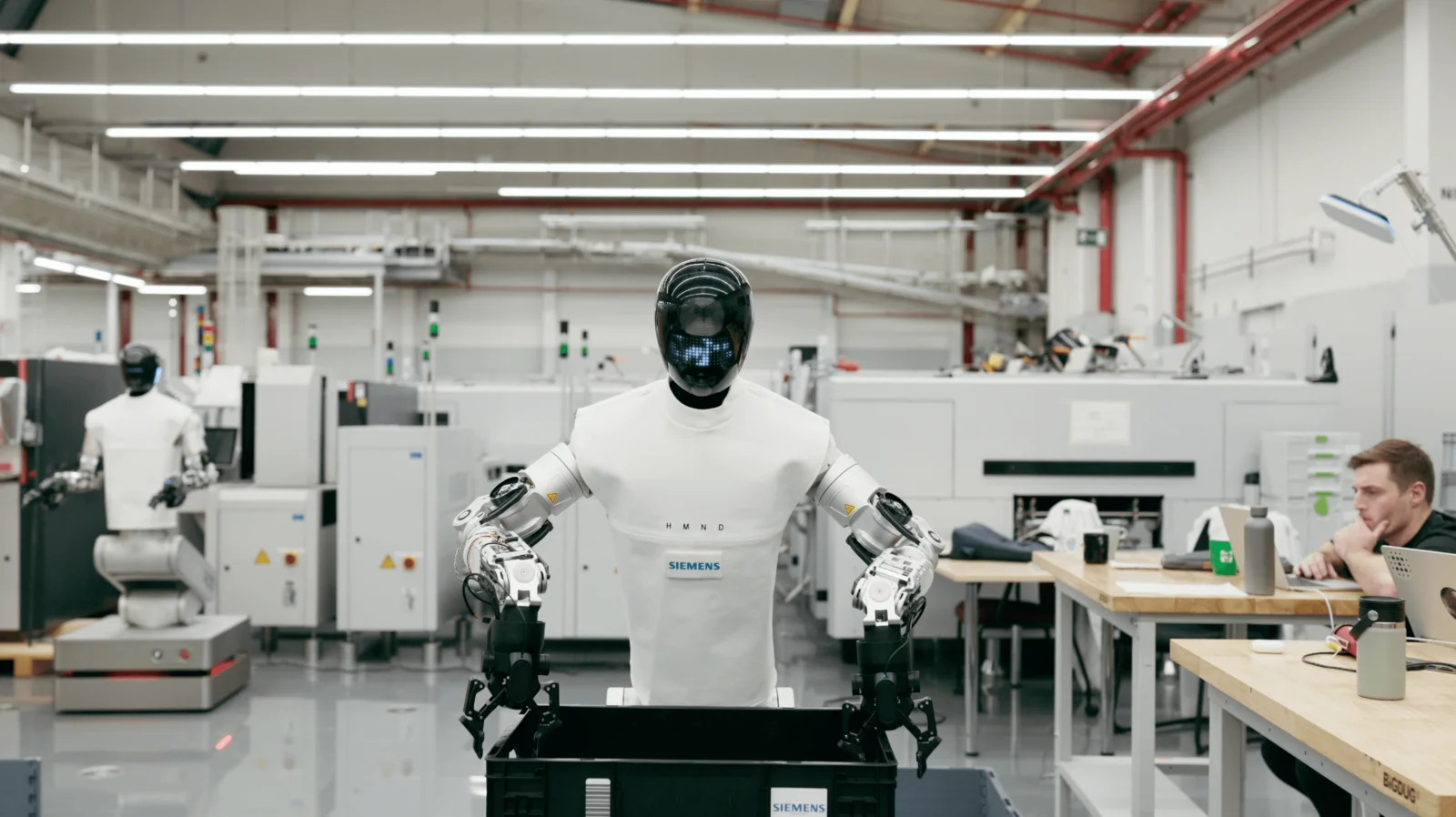
Siemens and the UK robot maker Humanoid said on April 16 that Humanoid’s HMND 01 Alpha, a robot with a humanoid upper body on a wheeled base, had been tested in operations at Siemens’ electronics factory in Erlangen, Germany. The robot picked up totes, carried them and set them down for human operators. Siemens said “all target performance metrics were met,” including 60 tote moves per hour, uptime of more than eight hours and an autonomous pick-and-place success rate above 90 percent.
The release presented the test as a milestone for the Siemens and NVIDIA partnership announced at CES. NVIDIA’s part is the computing stack. Humanoid runs NVIDIA Jetson Thor on the robot, used Isaac Sim for simulation and Isaac Lab for reinforcement learning and policy training. Humanoid also says simulation-first design cut prototype development from a typical 18 to 24 months to seven months. That is a company claim about its engineering process, and the factory test did not measure it.
The trial behind the announcement
The performance figures were not new in April. Humanoid published the same targets on January 15, when it announced a completed proof of concept with Siemens. That earlier release is more specific. The job was destacking: the robot took totes from a storage stack, moved them to a conveyor and placed them at a pickup point, repeating until the stack was empty. The on-site phase was a two-week deployment at the Erlangen plant, after an in-house phase in which Humanoid built a physical twin of the setup for testing.
The January list also contained two targets the April release dropped: handling two tote sizes, and “continuous autonomous task execution for more than 30 minutes.” That second figure reads differently next to eight hours of uptime. Neither release says how uptime was counted, how many totes were moved in total, or how often people stepped in. The Robot Report’s coverage in January relied on the companies’ own figures, and we found no independent measurement.
“Together, we’ve proven that humanoid robots are ready for real-world industrial deployment.”
Artem Sokolov, Humanoid founder and CEO, in the April 16 Siemens release
Two weeks of destacking at one plant is a narrower result than that sentence claims. It is still a defined task in a working factory with published targets, which is more than many humanoid announcements offer. Siemens’ own manufacturing lead was more measured in January. Stephan Schlauss, global head of manufacturing motion control, described the Erlangen plant as “Siemens’ customer zero” and said Siemens was “eager to advance this promising technology across our factory network.”
Wheels, not legs
Siemens describes HMND 01 Alpha as combining “an omnidirectional wheeled mobility platform with advanced manipulation capabilities.” For tote handling on a flat factory floor, that is a sensible match. The result says nothing either way about legged robots, which were not part of the test.
Both companies called the proof of concept a first step toward a long-term collaboration and said they may deploy more robots across Siemens facilities based on the robot’s skill set. No fleet size, contract value or date has been announced. The Robot Report noted that Humanoid also agreed that same week with Schaeffler to bring hundreds of its robots into Schaeffler plants over five years. The next useful disclosure from Erlangen would be a longer run with intervention counts, or a second Siemens site.