 Buy this domain
Anatomy
How a robot hand goes together
The ORCA Hand is an open-source robot hand with 17 powered joints, designed at ETH Zurich. Watch it assemble from its own CAD files, slow it down, or step through it one stage at a time.
Inspect the parts
No matching parts. Try a section or material name.
Forearm tower
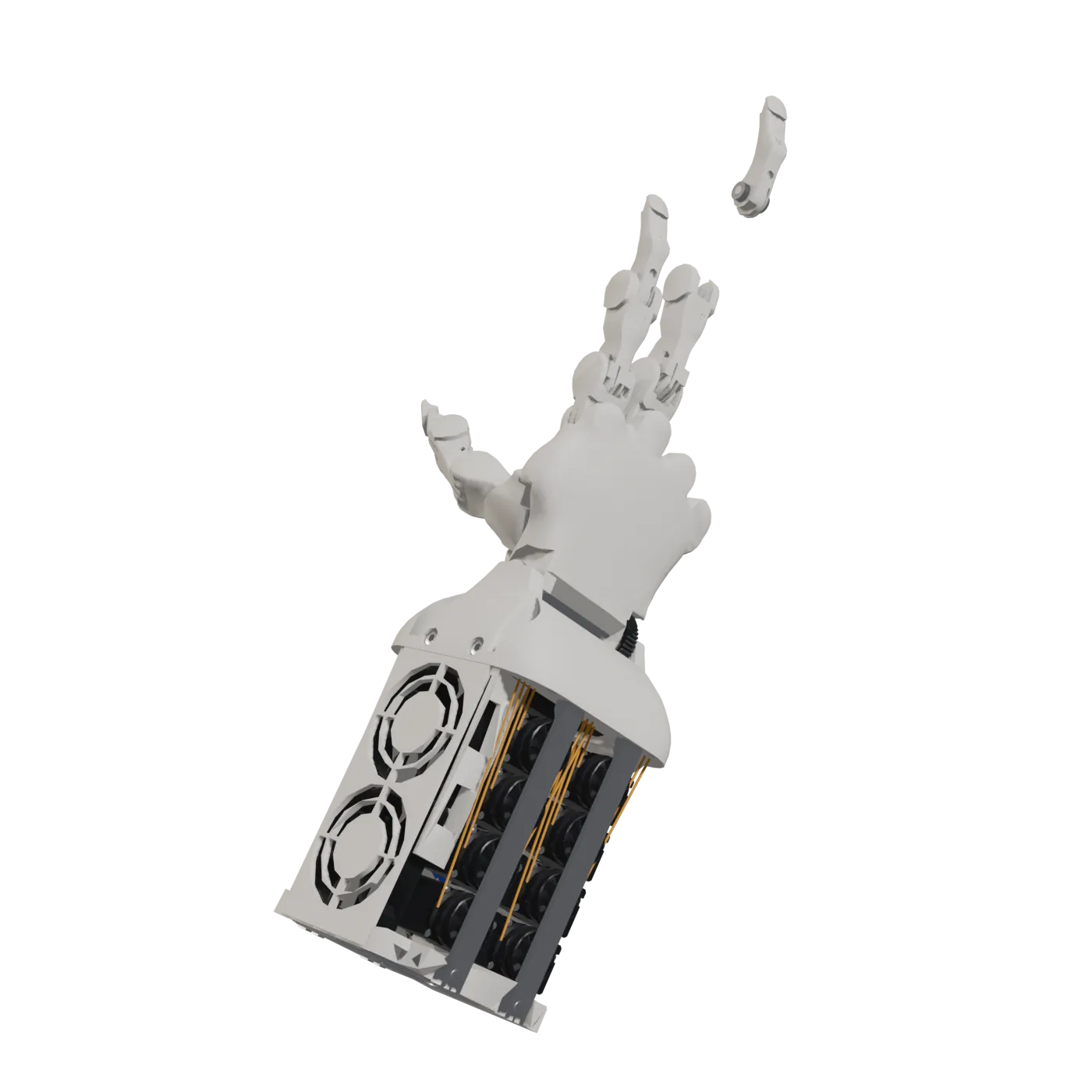
The printed tower is the forearm. It holds every motor, and a machined flange at its base bolts the hand to a robot arm.
All assembly stages (13)
The printed tower is the forearm. It holds every motor, and a machined flange at its base bolts the hand to a robot arm.
Sixteen Dynamixel XC330 servos fill the tower, one for each finger joint. Each turns a ratchet spool that winds a pair of tendons: one bends the joint, the other straightens it.
The tendons are 0.4 mm braided nylon line. Small connector boards link the servo cables.
Two fans cool the servo pack.
A larger XC430 servo drives the wrist through a GT2 timing belt instead of tendons, because the wrist carries more load. The paper gives it 60 degrees of flexion and extension.
The carpals form the palm. Thirty-two channels lined with PTFE tube guide the tendons through it, and a printed gear on its shaft meets the wrist belt.
The thumb has four joints. The one at its base lets it turn to face the fingers.
Each finger has three powered joints: one spreads it sideways, one bends the knuckle and one bends the middle joint. The joint nearest the tip is fixed by design.
Joints turn on small ball bearings seated in curved grooves. Under overload a joint pops out of place instead of breaking, and presses back in by hand.
Tendons bend around smooth metal pins rather than printed plastic, which cuts friction and wear.
In the paper’s version, each fingertip holds a pressure sensor whose wires run back through PTFE tubing inside the finger.
Skin goes on last. The team recommends cast silicone, which grips better and lasts longer than printed skin.
A circuit board and the hull panels close the forearm. The paper puts the finished hand at about 1.2 kg.