 Buy this domain
Anatomy
How a humanoid robot goes together
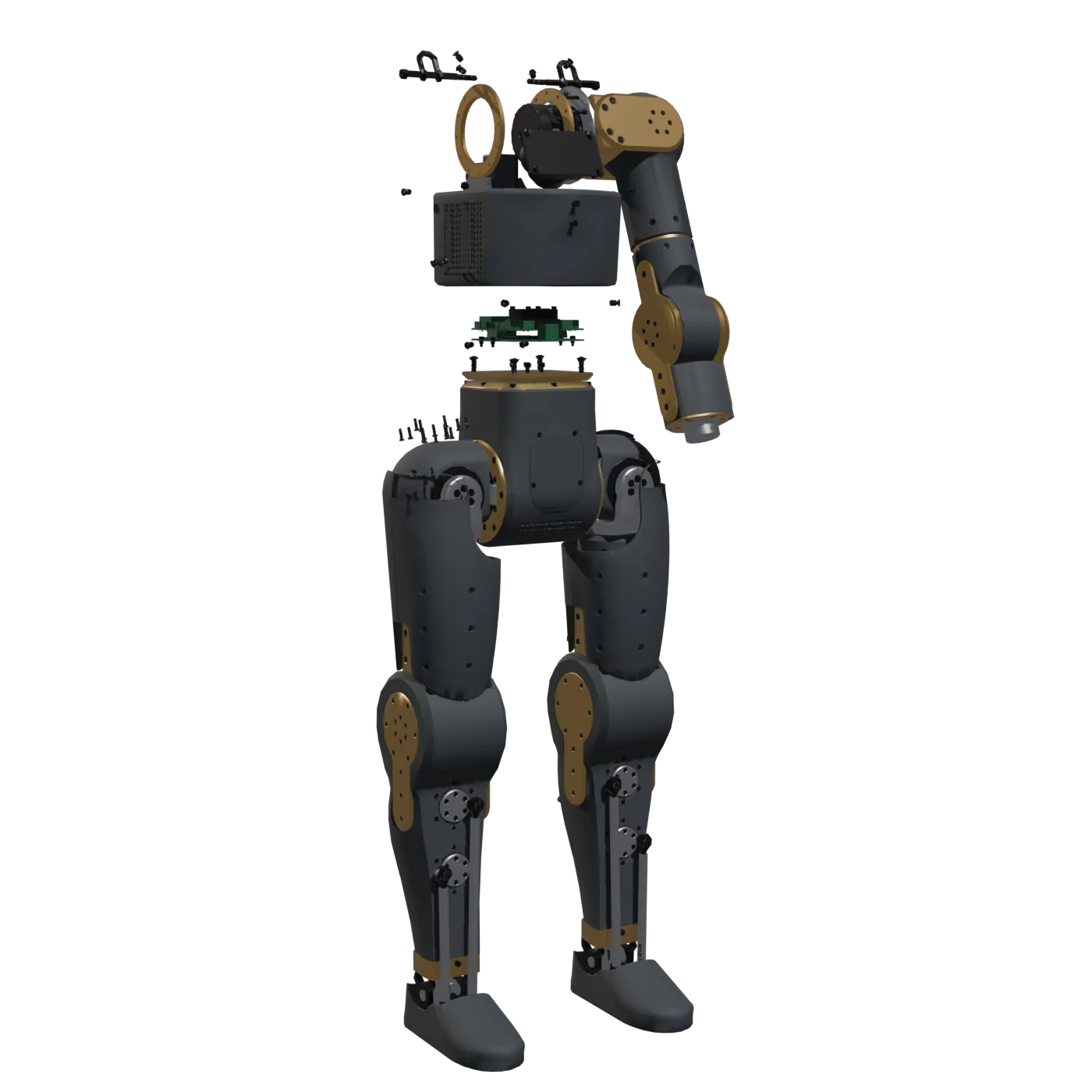
Asimov 1 is an open-source humanoid from Menlo Research: 1.2 m tall, 25 powered joints, built from machined aluminium and printed nylon. Watch it assemble from its own CAD files, slow it down, or step through it one section at a time.
Inspect the parts
No matching parts. Try a section or material name.
Left leg
The animation starts at the feet and works upward through the ankle, shin, knee and thigh. This is a visual tour of the CAD, not Menlo’s prescribed assembly order.
All assembly stages (9)
The animation starts at the feet and works upward through the ankle, shin, knee and thigh. This is a visual tour of the CAD, not Menlo’s prescribed assembly order.
The ankle uses a parallel linkage. Paired actuators and rods work together to tip the foot forward, backward and sideways. Inspect the lower leg to see the linkage hardware.
The pelvis holds five actuators: the waist actuator on top that turns the upper body, and the pitch and roll actuators for both hips. The legs hang from it.
The torso frame sits on the waist actuator. It carries the speaker that faces out of the chest and the mounts for the shoulders and neck.
The torso holds the battery and the Robot Processing Unit. The Motion Control Board combines a Radxa CM5 with its carrier board; the separate Power Distribution Board distributes electrical power.
Each arm has five powered joints: three at the shoulder, one at the elbow and one that turns the wrist. Hide the covers or inspect a group to see the actuator housings and brackets.
There are no working hands. Asimov ships without them, and Menlo supplies simple printed placeholder hands, which this model leaves out.
Two actuators move the head: one in the torso turns it, one in the head nods it. The head holds a Raspberry Pi 5 for media and networking, a 2 MP camera and a stereo microphone array.
Printed nylon covers close the torso. Finished, Asimov 1 stands about 1.2 m tall, weighs about 35 kg and has 25 powered joints.